Overview
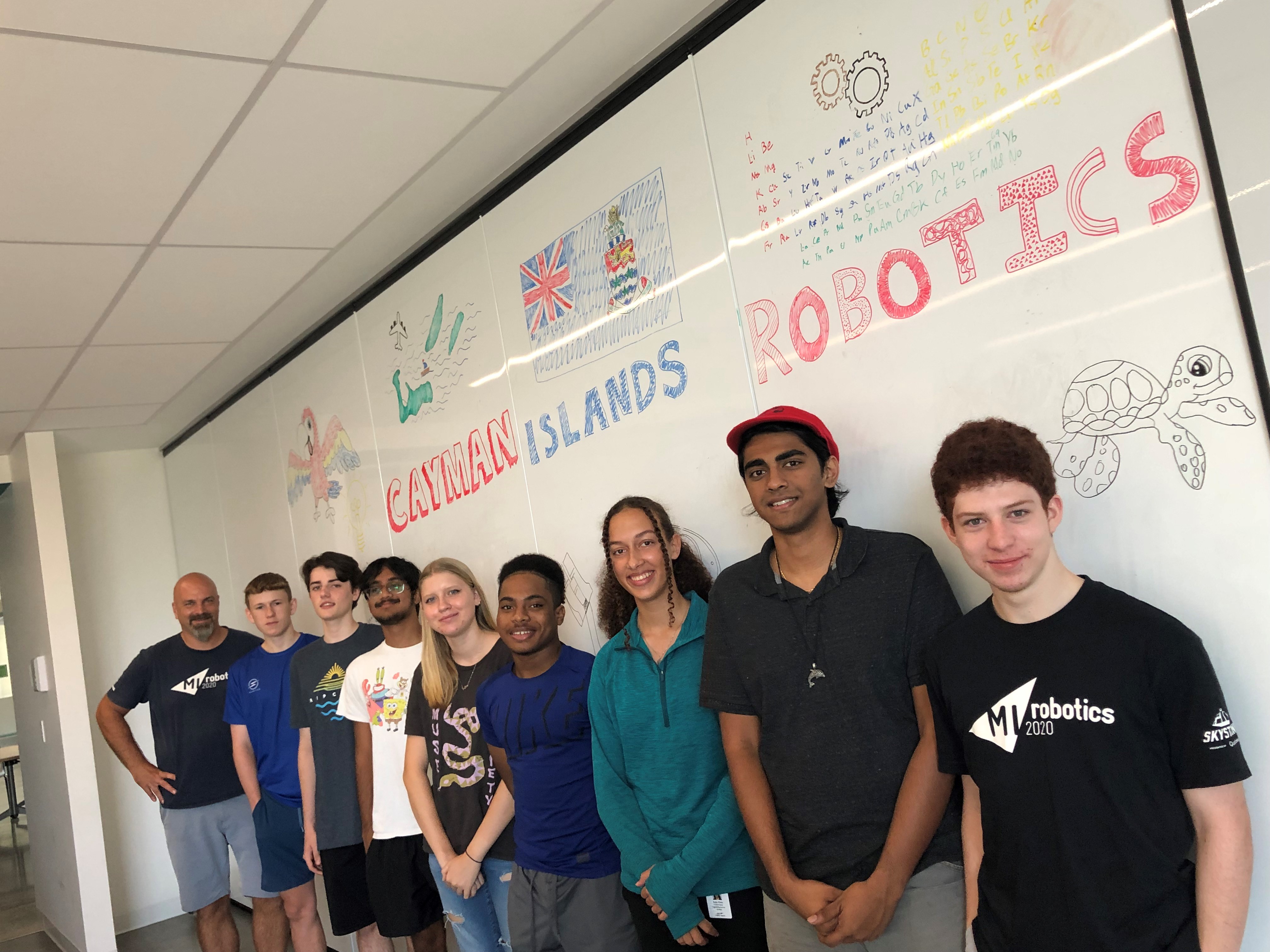
In 2021, I represented the Cayman Islands at the FIRST Global Challenge — an international robotics competition where each country sends a single team. Our 7-member team, based at Cayman International School and sponsored by Minds Inspired (through the DART program supporting STEM in the Cayman Islands), designed and built a competition robot from scratch.
This was the Cayman Islands' 4th year participating in the FIRST Global Challenge. Our team was featured in the official FIRST Global nations profile.
My Role
I was primarily responsible for:
- CAD design — Creating 3D models of robot subsystems using Fusion 360 and Onshape
- 3D printing — Manufacturing custom structural and functional parts using FDM printers
- System integration — Assembling mechanical, electrical, and control subsystems into a cohesive robot
Design Process
Each competition season followed an iterative design cycle:
- Game analysis — Understanding the year's competition challenge and constraints
- Concept generation — Brainstorming mechanisms for scoring, defense, and autonomous routines
- CAD modeling — Detailed design with interference checking and mass budgeting
- Prototyping — Rapid 3D printing and laser cutting to test mechanisms
- Integration & testing — Assembly, wiring, programming, and field testing
Results & Discussion
Competing at FIRST Global was a formative experience — it was the first time I worked under real engineering constraints with a hard deadline and an international stage. Building a robot from scratch with a small team meant everyone had to work across disciplines: I went from CAD modeling to soldering to debugging control logic in the same week.
The experience directly motivated my decision to study Mechanical Engineering at TU Eindhoven, and the hands-on skills (rapid prototyping, system integration, working under pressure) carried directly into my university projects.
Technologies Used
Fusion 360, Onshape, FDM 3D printing (Ultimaker Cura), Arduino, basic electronics, pneumatics