Overview
As part of the Computer Aided Engineering course (4GC00) at TU Eindhoven, our team of 7 redesigned the COLORADO 1650 printer carriage to meet strict dynamic performance requirements. The printer carriage is subject to vibrations from bearings, motors, and a chiller unit — all contributing to a problematic natural frequency around 50 Hz. Our goal was to shift all eigenfrequencies above 50 Hz (with a 10% safety margin to 55 Hz) and ensure no significant Bode plot peaks below 75 Hz.
The Problem
The existing carriage design had eigenfrequencies overlapping with the 50 Hz vibration sources in the machine, causing resonance that led to:
- Dot mispositioning in the y-direction during printing
- Inconsistent print quality
- Potential damage to sensitive components
The challenge was to create a frequency mismatch between the carriage's natural frequencies and external vibration sources while maintaining structural integrity, minimizing weight, and keeping manufacturing costs low for ~1000 units/year.
Design Approach
We followed a three-step iterative design process:
- Baseline analysis — Identified problematic eigenfrequencies using FEA with both compliant spring and RBE2 element configurations
- Component redesign — Strategically stiffened the carriage through 10 new/modified parts, each targeting specific vibrational modes
- Verification — Eigenfrequency analysis, Bode plot evaluation, and mesh refinement study
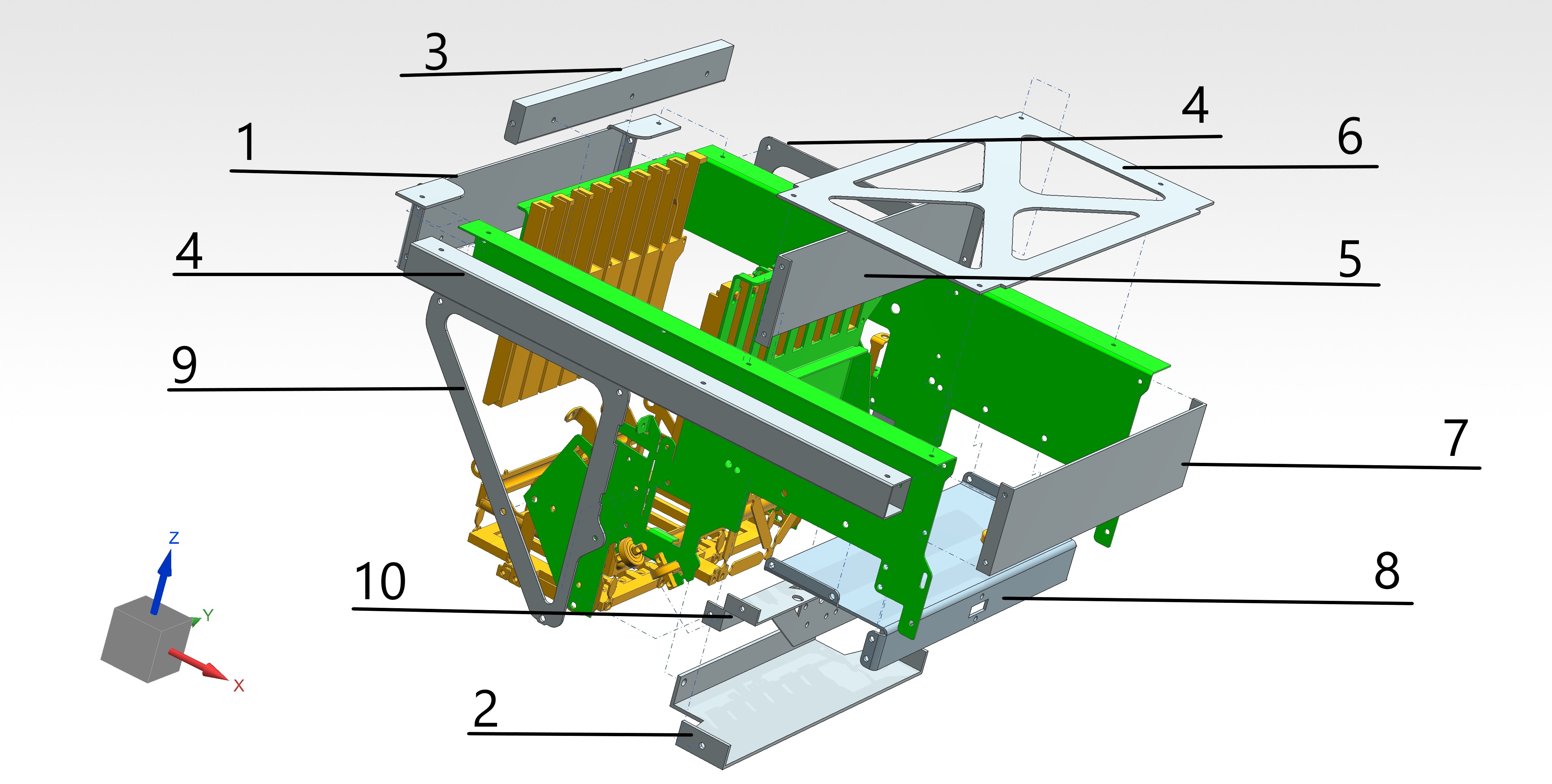
Key Design Decisions
- Parts 1, 3, 4, 9: Connected side plates to the front center module, reducing X-axis rotation and Y-axis compression
- Parts 2, 5, 10: Extended the middle section with additional attachment points, taking load off the hinge system
- Parts 6, 7: Enclosed lateral plates with both external and internal support for balanced dynamic performance
- Part 8: L-shaped bearing support to resist Z and X-axis rotation
Results
All structural eigenfrequencies were pushed well above the 75 Hz target:
| Mode | Eigenfrequency (Hz) |
|---|---|
| 7 | 81.4 |
| 8 | 94.9 |
| 9 | 113.2 |
| 10 | 116.4 |
(Modes 1–6 are rigid-body modes near 0 Hz and are not constrained by the resonance requirement.)
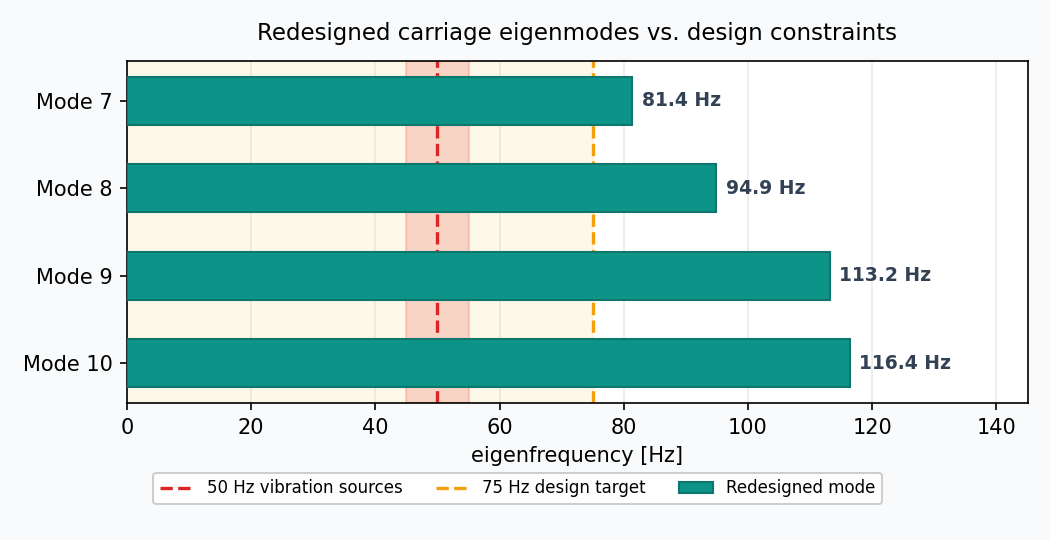
Final-design eigenfrequencies (Table 4.2) plotted against the 50 Hz vibration-source danger zone and the 75 Hz no-peak design target. The lowest structural mode sits 31 Hz above the danger band and 6 Hz above the design target.
The FEA-based Bode plots confirmed no significant peaks below 75 Hz, meeting all dynamic requirements with margin to spare.
Results & Discussion
This project taught me to think about mechanical design from a dynamic perspective — not just static strength, but how structures respond to vibration. The iterative process of running eigenfrequency analysis, identifying problematic modes, and strategically adding stiffness became a powerful design methodology. Working with an industry-relevant application (Canon printer hardware) added practical context to the FEA theory.
Technologies Used
FEA software (Siemens NX Nastran), Siemens NX (CAD), eigenfrequency/modal analysis, Bode plot analysis, mesh refinement studies