Overview
In this CBL project (4GB10, Q3 2024) at TU Eindhoven, our team of 8 investigated whether ethanol-blended gasoline could serve as a more efficient and sustainable alternative to pure gasoline. We combined physical engine experiments with MATLAB thermodynamic modeling to answer:
To what extent are ethanol-blended fuels (E0, E5, E10, E15) more efficient and sustainable than pure gasoline in a Honda GX200 engine?
Approach
Experimentation
We conducted two sets of physical experiments on a Honda GX200 engine:
- Engine disassembly — Measured internal dimensions (bore, stroke, combustion chamber volume) to parameterize the model
- Performance testing — Ran the engine with E0, E5, E10, and E15 fuel blends at different loads, measuring pressure traces (pV diagrams) and torque output
MATLAB Modeling
We built two progressively complex thermodynamic models:
Simple Model — Ideal Otto cycle with key assumptions:
- Stoichiometric air-fuel ratio ()
- Adiabatic compression and expansion (Poisson's relations: )
- Instantaneous combustion at TDC
- Temperature rise from lower heating value:
Advanced Model — Reduced assumptions for realism:
- Heat loss modeling (convection through cylinder walls)
- Non-instantaneous combustion with finite burn duration
- Variable specific heat ratios
- Changing mass fractions during combustion
CO2 Lifecycle Analysis
Beyond engine performance, we conducted a lifecycle analysis comparing corn-based ethanol production emissions against conventional gasoline, including agricultural, refining, and combustion contributions.
Results
The comparison between simple model, advanced model, and experimental pV diagrams showed how each layer of complexity improved accuracy. The advanced model captured heat losses and realistic combustion timing that the simple model missed entirely.
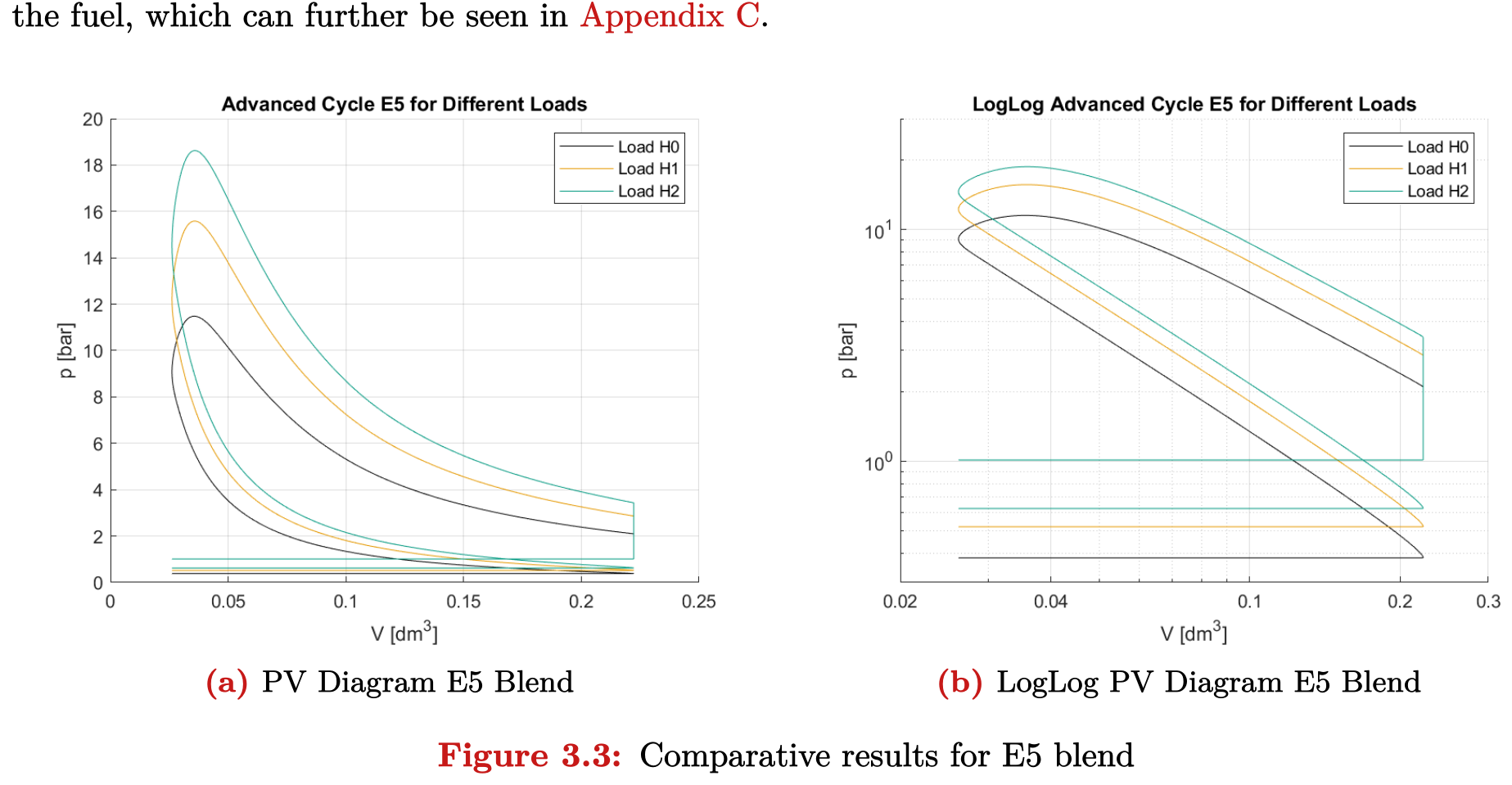
Advanced-model traces for E5 across three load settings (Honda GX200, heater settings H0/H1/H2). The right-skewed loops capture the heat-loss and finite-burn-duration effects the simple Otto cycle misses; peak pressures rise from 11.5 bar (H0) to 18.6 bar (H2).
BSFC (Brake Specific Fuel Consumption) and specific CO2 emissions were calculated across all fuel blends and load conditions, providing a quantitative basis for evaluating biofuel viability.
Results & Discussion
This project taught me the gap between textbook thermodynamics and real engine behavior. The simple Otto cycle model was elegant but wildly optimistic — adding heat loss alone changed the predicted efficiency by over 30%. The hands-on engine work (disassembly, fuel mixing, pressure measurement) grounded the modeling in physical reality.
Technologies Used
MATLAB (thermodynamic modeling), Honda GX200 engine test bench, pressure/torque sensors, LaTeX